Wind Speed Sensor Performance
The E-Sensor anemometer was evaluated against a reference-grade anemometer, Climomaster 6501 (probe 6543-21, hot-wire), as the true-value standard, covering accuracy, linearity, response, variability, and directional dependence. The measurement range is 0.0 – 5.0 m/s.
- Accuracy: within about ±5% for 0.5–2.5 m/s; linearity R² = 0.998.
- Low speed: below 0.5 m/s, the absolute error is about 0.1 m/s.
- Response: follows changes without lag, overshoot under 1%, negligible hysteresis.
- Stability: noise comparable to the actual airflow fluctuation; stable zero at no wind.
- Directionality: about ±8% around the mean; most accurate with the blue face into the wind.
The values on this page are one example measured for unit 97B15211 in a wind tunnel. They vary somewhat with the individual unit, mounting, and air temperature. Use them as a guide for educational / indoor-environment measurement.
Accuracy & Linearity
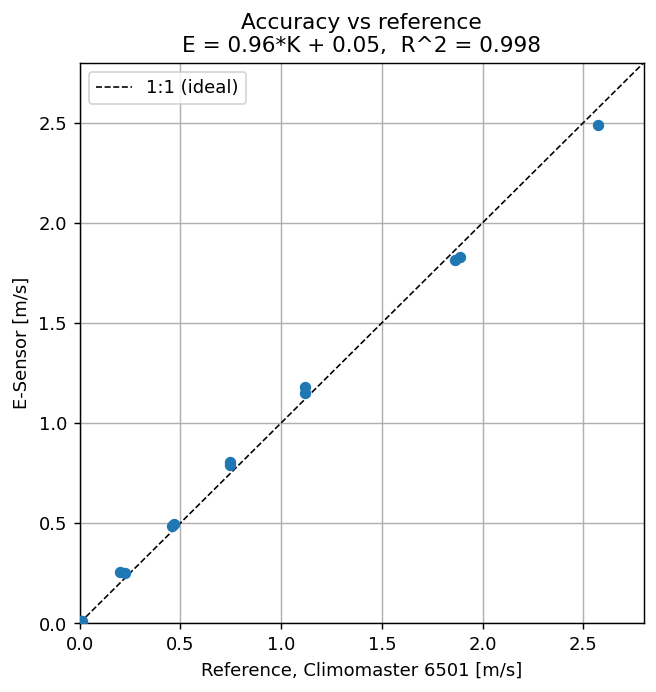
The horizontal axis is the reference reading (Climomaster 6501); the vertical axis is the E-Sensor reading. The closer the points lie to the diagonal (1:1), the more accurate the sensor. R² = 0.998 indicates high linearity.
| Speed range | Accuracy (vs. reference) |
|---|---|
| 0.5 – 2.5 m/s | within about ±5% |
| below 0.5 m/s (low speed) | about 0.1 m/s in absolute terms |
| Linearity | R² = 0.998 (E ≈ 0.96 × reference + 0.05) |
Staircase up / down
Record of increasing the wind speed in steps (ascending) and then decreasing it (descending). The E-Sensor tracks the reference well, and the difference between the ascending and descending paths (hysteresis) is small.
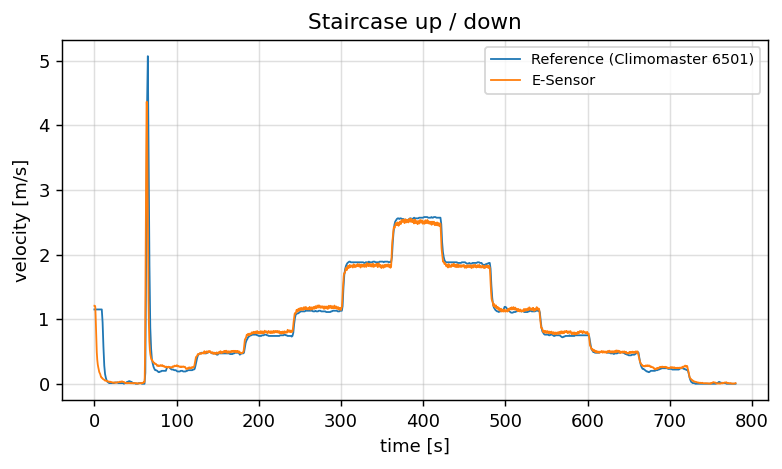
The leading spike (pulse) at the start of the graph is a transient from the wind-tunnel fan start-up as the measurement begins after warm-up; it is not a behavior of the E-Sensor.
Sampling interval: the reference (Climomaster 6501) updates every 1 s, while the E-Sensor updates about every 0.2 s (4–5 times per second) — this is why the E-Sensor trace is finer.
Response & Stability
| Item | Result |
|---|---|
| Tracking | follows wind changes without lag (lag ≈ 0 vs. reference), overshoot under 1% |
| Hysteresis | ≤ 0.03 m/s (difference between up and down; negligible) |
| Noise | comparable to the actual airflow fluctuation (little sensor-added noise) |
| Zero | 0.004 m/s at no wind; stable (negligible drift) |
Being a hot-wire type, the reading stabilizes after a warm-up of a few tens of seconds. Immediately after power-on, while still cold, it reads slightly low.
Repeated high / low
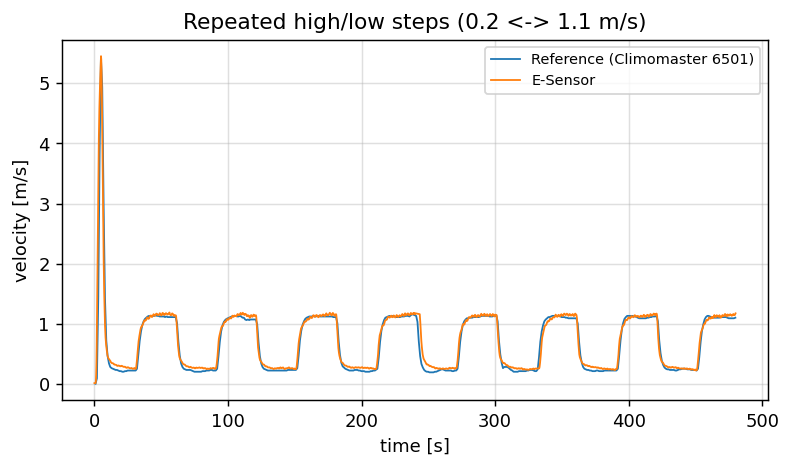
Record of repeatedly switching between high (about 1.1 m/s) and low (about 0.2 m/s) wind speeds. The E-Sensor follows each change without lag and returns to the same value on every cycle (high repeatability).
Continuous change (ramp)
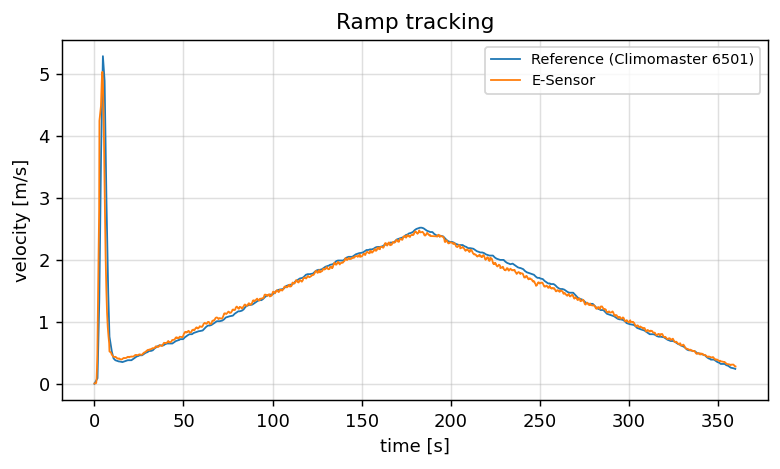
Record of continuously increasing and then decreasing the wind speed (ramp). The E-Sensor tracks the reference almost exactly.
Directional Dependence
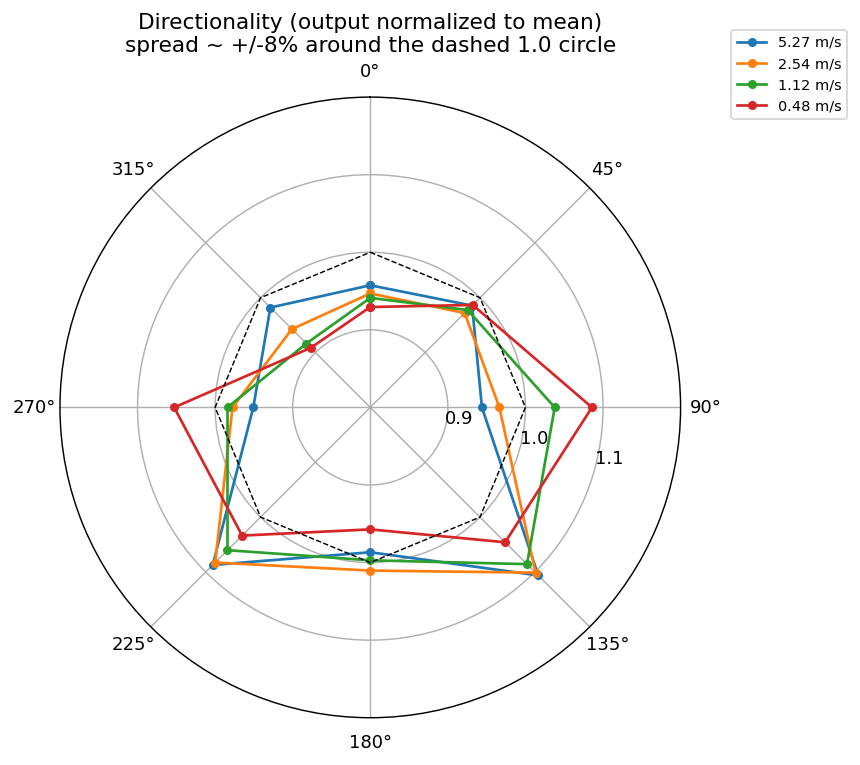
Because the detector has a flat shape, the reading changes slightly with the horizontal wind direction. In the figure below, each speed's reading is normalized to its mean; the deviation from the dashed circle (= 1.0) is the directional variation.
| Item | Result |
|---|---|
| Directional variation | about ±8% around the mean (nearly constant across speeds) |
| Most accurate orientation | blue face facing the wind (= the orientation giving the maximum output) |
| Absolute error | about 0.1 m/s at low speed; larger at higher speed |
Keeping the orientation constant largely avoids the directional effect.
Method
The reference (Climomaster 6501, probe 6543-21) and the E-Sensor were measured sequentially with the same fan-drive schedule (warm-up → staircase up/down → repeated steps → holds → gentle ramp) and compared with the time bases aligned (tunnel 1, single unit). Directionality was measured at 8 azimuths in 45° steps.